


Return to player and house edge get quoted everywhere, promised by no one, and understood by few. They are two sides of the same coin: one counts what cycles back to players over the long run, the other counts what the casino keeps. Get them straight and you can compare games, judge a bonus, and read a session honestly. Treat them as a prediction for tonight and they will mislead you every time.
Here is the one-line version we will spend the rest of this guide earning: the house edge is the price you pay to play a game over time, RTP is the change you get back, and volatility decides whether that price arrives as a quiet drip or a wild ride.
How RTP and House Edge Are Related
For games where the two are complementary, they are simply the same number from opposite ends:
- RTP = 100% minus house edge
- House edge = 100% minus RTP
So a 96% RTP is a 4% house edge, 97% is 3%, and 98% is 2%. RTP is the theoretical share of all bets paid back to players over a very large number of rounds. House edge is the theoretical share the casino keeps. The two add up to 100% for fixed-rules games, though some products use other mathematical indicators, so the formula is not universal.
That is the textbook part. The useful part is what the house edge actually represents: a price. A 4% edge means that, over the long run, the game is designed to cost you 4 cents on every dollar wagered. Not deposited. Wagered. Hold on to that distinction, because it is where most players misread their own losses.
How to Calculate Your Expected Cost
RTP applies to your total turnover, meaning everything you stake, not the amount you first deposit.
Say a game runs at 96% RTP and you wager $1,000 in total across many rounds:
- $1,000 x 96% = $960 theoretical return
- $1,000 x 4% = $40 theoretical cost to you (the house edge in dollars)
That $40 is not a fee deducted from your account and the $960 is not handed back at the end of the night. It is what the maths expects over a long run of play. Your real session could land far above or far below it. RTP is a long-run average, not a guaranteed return.
Why your deposit is the wrong number to measure
Here is the trap. Deposit $100, win some, bet it again, win some, bet again, and your turnover climbs far past $100. If you cycle that bankroll until you have staked $500, the house edge is charged on $500, not on your original $100. Turnover is what the maths bites, and recycled winnings are still turnover.
A real example: $100 at Drakaris
We will use a slot at Drakaris to make this concrete (you can see how its game library is laid out in our Drakaris Casino review). Picture a 96% RTP slot, $1 per spin, starting with a $100 deposit.
You do not play 100 spins and stop. You win a bit, those wins go back in, and across the session you rack up $500 of total turnover before the bankroll runs dry or you cash out. On that $500, the 4% edge expects to take $20, not the $4 you might assume from your $100 deposit.
Now watch what variance does to the same 96% game over that short session:
- Cold run: a dead patch of spins, no feature, and you are out before you finish your coffee.
- Hot run: a bonus hits early, you are suddenly up to $230, and you either bank it or feed it back.
- The grind: small wins keep you alive for an hour and you drift down to $75.
All three are completely normal for a 96% RTP slot. Read that twice: the published RTP described none of those three nights. It only describes the average of thousands of them.
What RTP Does and Doesn’t Tell You
RTP is genuinely useful for comparing the theoretical return of similar games. It is useless as a forecast of your afternoon. These are different measures doing different jobs:
| Measure | What it tells you | What it does not tell you |
| RTP | The game’s theoretical long-run return from wagers | Whether you will profit in a session |
| House edge | The casino’s theoretical long-run share of wagers | How much you will lose on your next bet |
| Volatility | How payouts are distributed and how much results swing | The game’s overall theoretical return |
| Hit frequency | How often a winning outcome lands | The size or total value of those wins |
| RNG | How outcomes are generated in RNG games | Whether your next spin will win |
If you want to pick a slot by more than its headline percentage, our guidance on choosing real-money slot by RTP and volatility walks through reading all of these together.
Why a 96% RTP Game Does Not Hand You $96 for Every $100
A 96% RTP does not refund $96 of every $100 you wager. It is an average drawn from an enormous sample of play, and any single stretch can land miles from it. Independent test labs that certify these games describe RTP exactly this way: a long-run average, with wide short-term swings driven by volatility.
That is precisely how you can stake $100 on a 96% slot and walk away with $0, $50, $200, or more. None of those outcomes mean the game is broken or due. They mean you played a short sample of a long-run number.
Progressive jackpot slots stretch this further, because part of their theoretical return is parked in a jackpot that almost nobody hits. If you want to see where that diverted return goes, how progressive jackpots work explains the trade-off.
RTP, Volatility and Win Frequency Are Not the Same Thing
A higher RTP does not mean more wins. It is a common and expensive assumption.
Two games can share an identical 96% RTP and feel nothing alike. One pays small and often, the other pays rarely but big. That is volatility: the shape of how the return is delivered. Hit frequency is a separate thing again, meaning how often any win lands, and a win is not always a profit on that spin.
- Slot A: frequent small wins, a gentle ride, your bankroll bleeds slowly.
- Slot B: long dry spells broken by the occasional large hit, far swingier.
Same theoretical return, completely different sessions. RTP tells you the long-run payback. Volatility tells you how brutal or how smooth the trip to that average is likely to be.
Why the Same Game Can Show Different RTPs
The same slot title is often shipped in several RTP settings, for example 94%, 96% and 98%. The operator or jurisdiction decides which build goes live, so an identical-looking game can carry a different theoretical return from one casino to the next. Table games shift their edge through rules rather than settings.
Roulette shows this cleanly
- European roulette has a single zero, giving standard bets a 2.70% house edge.
- American roulette adds a second zero, pushing the same bets to a 5.26% edge.
Same name, nearly double the cost, purely from one extra pocket. It is the clearest proof that the rules, not the label, set the price. If you are new to the layout, the difference between European and American roulette odds breaks down each bet. The takeaway: check the specific game’s rules or info screen rather than trusting a figure you found elsewhere.
RTP and House Edge Across Common Casino Games
The edge depends on the game, the rules, and sometimes your own decisions:
| Game | Example theoretical house edge | What changes it |
| European roulette | 2.70% | Single-zero wheel |
| American roulette | 5.26% | Double-zero wheel |
| Baccarat, Banker | 1.06% | Standard rules and 5% commission |
| Baccarat, Player | 1.24% | Standard rules |
| Blackjack | Varies | Decks, table rules and your strategy |
| Slots | Varies by configuration | RTP setting, design and features |
Blackjack is the one game here where your choices move the number: played well it carries one of the lowest edges on the floor, played loosely it climbs fast, which is why it rewards learning blackjack odds and house edge before you play. These figures are examples, not fixed values. For the full map of game types and where each sits, see which online casino games have the highest RTP in Canada.
Where to Find a Game’s RTP
RTP usually hides in the game’s help, information, or rules menu, though the spot moves around by platform. Look for an “i”, a “?”, a paytable, or a game-information button. If the screen does not show it, check the operator’s game information or the provider’s documentation.
One warning: the live figure can differ from what third-party sites quote, especially for titles that ship in multiple configurations. The number inside the game is the one that counts.
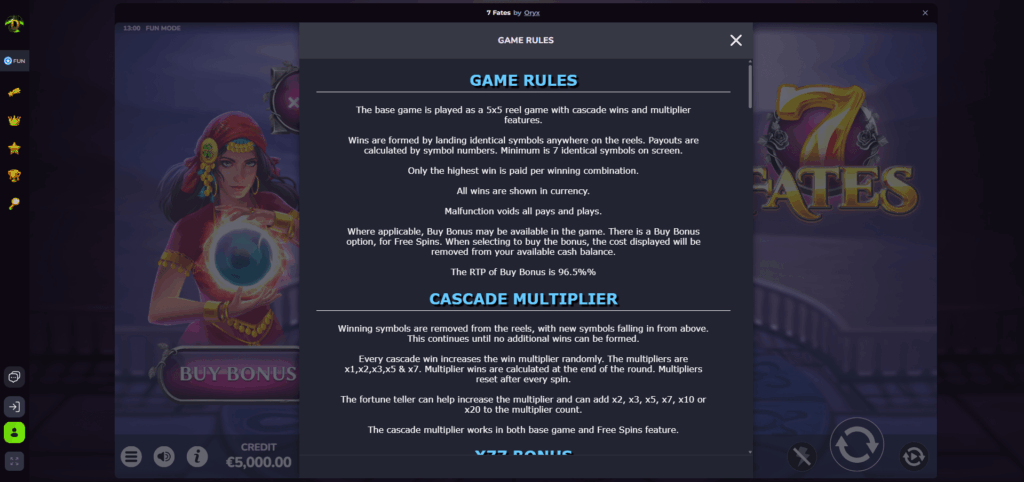
The 7 Fates slot game at Drakaris Casino displays a 96.5% RTP for its Buy Bonus feature within the Game Rules menu.
Can a Bigger Bet Change Your RTP?
No. If a game has a fixed RTP, bet size does not touch the percentage. A 96% game is 96% whether you stake $1 or $5.
What does change is the dollar impact. At a 4% edge, $1,000 of turnover carries a $40 theoretical cost and $10,000 carries $400. The percentage holds steady; the dollars scale with how much you put through the game. Which loops back to the earlier point: turnover is the number that matters.
Why Your Session Can Swing Far From the Published RTP
A single session can finish well above or below the published figure because that figure is averaged over a vast number of rounds. A 96% game might return 70%, 110%, or anything else across a short sitting. The outcomes are produced by a random number generator, and in how random number generators keep casino outcomes fair we explain why past spins never nudge the next one.
As play piles up, real results drift closer to the theoretical RTP, though some variation always remains, shaped by volatility and sample size. The point to hold on to: a short session can never prove a game is paying above RTP or due to catch up.
Common RTP and House Edge Myths
- “A 96% RTP gives me back $96 of every $100 I deposit.” RTP applies to total wagering over the long run, not your deposit.
- “Higher RTP means I win more often.” RTP says nothing about win frequency. Volatility and hit frequency do.
- “The game is due after a losing streak.” In an RNG game, past results do not change the next outcome.
- “A bigger bet buys better RTP.” A fixed RTP does not budge when the stake changes.
- “My session returned 80%, so the game is broken.” Short-run returns differ from theoretical RTP because of variance and sample size.
What RTP and House Edge Are Actually Good For
Used as long-run comparison tools, they earn their keep. They help you:
- Compare the theoretical return of similar games
- Understand the casino’s built-in advantage
- Separate game maths from short-term luck
- Put a winning or losing session in its proper statistical context
They cannot tell you whether your next game wins, how long your money lasts, or whether tonight turns a profit. Return to player is the long-run payback; house edge is the matching casino cut; neither predicts the session in front of you.
Responsible Gambling Context
Knowing the maths does not lower the risk. RTP and house edge explain how a game is priced, not how an evening will go. Set your budget on what you can afford to lose, not on a game’s published return, and never raise your stakes because a slot advertises a higher RTP. A good habit here is deciding your limits in advance, which is the whole point of our bankroll management guide.
If gambling is causing financial stress or affecting your well-being, take a break and use the responsible gambling resources available in your province.
Written and Reviewed By
Common Questions About RTP and House Edge
Where can I find a game's RTP?
Usually in the game’s help, information, or rules section, behind an “i” or “?” button. If it is not shown, check the operator’s game information or the provider’s documentation.
Can the same slot have more than one RTP setting?
Yes. Many titles ship in multiple configurations, and the version live can vary by operator or jurisdiction, so trust the current info screen over a figure from another casino.
Does a bigger bet change RTP?
No. A fixed RTP stays the same whatever you stake. Bet size only changes the dollar value of the house edge, not the percentage.
Why can my session result differ so much from the published RTP?
Because RTP is a long-run average, not a session forecast. A small number of rounds can land well above or below the published figure thanks to variance and volatility.
The bottom line: RTP tells you the price of the game, not the result of your night. Learn to read it, then go in with a budget, not a prediction.