


Craps is a dice game where you bet on roll outcomes. This guide covers how it works, which bets matter, and how online play differs from casino tables. It’s written for beginners, based on testing actual online craps platforms.
Quick Summary
- Craps is a dice game where you bet on roll outcomes. Pass and Don’t Pass bets carry a 1.36-1.41% house edge. Proposition bets run above 10%. Online play uses RNG software instead of physical dice, which affects pace and interface. The table layout looks complicated, but the mechanics are straightforward once you understand the come-out roll and point phases.
- Every bet except odds bets carries a house edge. No strategy can overcome that mathematical reality. If you play, stick to low house edge bets, understand the expected cost based on your wagering level, and set clear limits on losses and time.
- This guide covers how the game works online. Whether you play is a personal choice that should be based on understanding what you’re getting into.
Testing Methodology
This guide is based on direct testing at 12 Canadian-facing online casinos. We followed our testing methodology which includes hands-on gameplay across both RNG and live dealer variants on desktop (Chrome/Safari), iOS Safari, and Android Chrome. We reviewed interface behaviour, verified payout tables against documented house edge calculations, and observed bet timers, UI responsiveness, and common friction points.
This guide covers: rules consistency, available bet types, table layout clarity, demo mode availability, bet placement flow, and round pacing.
This guide does not: withdrawal processing, account verification timelines, or customer support response times.
Content undergoes quarterly updates to reflect changes in platform conditions and available information.
How to Bet When Playing Online Craps
The online betting process differs from physical casinos in execution, though the underlying concepts are the same.
Step-by-step betting process (RNG Craps)
- Select chip denomination: Click on the chip value you want to wager (typically ranging from $1 to $100 or more)
- Click betting area: Click on the table layout area corresponding to your desired bet type (Pass Line, Don’t Pass, Field, etc.)
- Confirm or adjust bet: Some interfaces require confirmation; others place the bet immediately. You can usually click the same area multiple times to increase your wager or hit a “clear” button to remove bets.
- Roll dice: Click the “Roll” or “Shoot” button to generate the dice outcome.
- Review results: The interface displays the dice result and automatically resolves winning and losing bets
- Continue or cash out: Place new bets for the next roll or end your session.
Live dealer betting process
Live dealer play uses a similar digital betting interface, but with some important differences:
- A timer appears showing how long you have to place bets before the dealer closes betting
- You watch a video stream of a real dealer and physical dice
- The dealer announces results verbally and manages the physical game
- Betting windows are shorter than RNG play because you must wait for the dealer’s procedures
- Chat features allow interaction with the dealer and other players
During testing, I found that live dealer tables require more attention to timing. You can’t pause the game or take unlimited time deciding on bets. The social element and visual confirmation of physical dice may appeal to some players, while others prefer the faster pace and full control of RNG versions.
How a Craps Round Works
Each round follows a fixed sequence. Dice outcomes determine which bets win or lose.
The come-out roll
Every round starts with a come-out roll after bets are placed. This roll either produces an immediate result or sets a point for continued play.
In online craps, you press Roll to generate the result.
Come-out roll outcomes:
- Natural (7 or 11): Pass Line bets win at 1:1. Don’t Pass bets lose. The round ends.
- Craps (2, 3, or 12): Pass Line bets lose. Don’t Pass bets win on 2 or 3, but 12 typically pushes. The round ends.
- Point (4, 5, 6, 8, 9, or 10): Any of these numbers establishes the point. An ON marker appears on that number. The shooter continues rolling, trying to hit the point before rolling a 7.
Point phase
Once a point is set:
- If the point number appears before a 7, Pass Line bets win and Don’t Pass bets lose.
- If a 7 appears first, Pass Line bets lose and Don’t Pass bets win (sevening out).
Other numbers don’t affect Pass or Don’t Pass bets.
After either result, a new come-out roll begins.
Understanding the Craps Table Layout
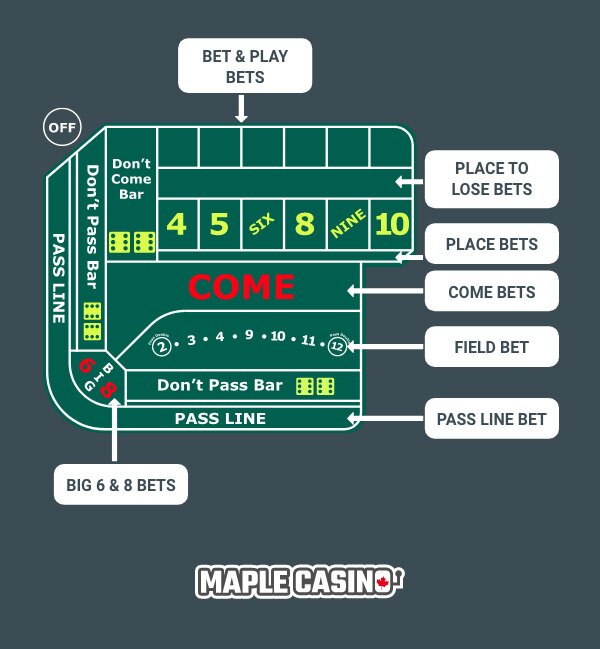
The craps table displays all betting areas. Physical tables mirror both sides for multiple players. Online versions typically show one side.
Main betting areas
- Pass Line: The prominent betting area along the outer edge. Bets must be placed before the come-out roll.
- Don’t Pass Bar: Located near the Pass Line. “Bar 12” means a 12 on the come-out roll pushes.
- Come/Don’t Come: Used after a point is established. These work like Pass and Don’t Pass bets.
- Field: Covers 2, 3, 4, 9, 10, 11, and 12. Wins if any of these appear on the next roll.
- Place Bet Numbers: Boxes for 4, 5, 6, 8, 9, and 10. Bet that a specific number appears before a 7.
- Proposition Bets: Centre area one-roll bets on specific outcomes. Highest house edge.
- Odds Bet Area: Behind Pass/Don’t Pass or Come/Don’t Come bets. Used after a point is established.
Interface variations
Online craps interfaces vary. In our testing sample, most platforms highlighted available bets based on game phase, while others kept all options visible. Live dealer games show video feed alongside digital betting. Specific interface behaviour can differ by operator and device.
Key Differences between Online vs. Physical Craps
Online craps works differently than the physical casino version in ways that genuinely affect your experience and expectations.
| Feature | Online (RNG) | Physical Casino |
| Dice Mechanics | Random Number Generator (RNG): Software determines outcomes; tested and certified for fairness. | Physical Dice: Real dice tumbled across a felt table by a human shooter. |
| Pace of Play | Significantly Faster: No waiting for others; you control the tempo entirely. | Traditional: Slower due to dice handling, dealer procedures, and player interaction. |
| Social Aspect | Solitary: Mostly independent play, though Live Dealer versions offer chat features. | High Interaction: Authentic social atmosphere and “energy” of a crowded floor. |
| Betting Interface | Digital: Clicking chip denominations; software highlights active/available bets. | Manual: Physically placing chips on a felt layout; requires more manual tracking. |
| Regulatory Oversight | Digital Certification: Fairness verified by labs like eCOGRA or iTech Labs. | On-Site Oversight: Regulated by provincial or international gaming authorities. |
RNG play is significantly faster because there are no dealer procedures or dice handling. This faster tempo means you place more bets per hour, which exposes your bankroll to the house edge more quickly.
Online play replaces physical chips with a digital interface. The software typically guides you by highlighting valid betting areas based on the game state (come-out roll vs. point established), though this varies by platform
Types of craps
Pass Line Bet
Win on 7 or 11. Lose on 2, 3, or 12. If a point is set, win if that number appears before a 7.
House edge: 1.41%
Don’t Pass Bet
Win on 2 or 3. Lose on 7 or 11. 12 pushes. After a point is set, win if 7 appears before the point.
House edge: 1.36%
Come Bet
A Pass Line bet placed after the point is established. The next roll becomes your personal come-out roll. 7 or 11 wins immediately. 2, 3, or 12 loses immediately. Any other number becomes your personal point.
House edge: 1.41%
Don’t Come Bet
The opposite of Come. Works like Don’t Pass, placed after the point is established.
House edge: 1.36%
Odds Bets
Additional wagers behind Pass/Don’t Pass or Come/Don’t Come after a point is set. These carry no house edge because they pay true mathematical odds. They must pair with an existing base bet.
Casinos typically limit odds to 3x, 4x, 5x, or 10x the original wager.
Adding odds lowers the overall house edge on your combined bet but doesn’t remove the edge on the base bet.
Place Bets
Bet that a specific number (4, 5, 6, 8, 9, or 10) appears before a 7. These stay active until they win or a 7 appears.
- Place 6 or 8: pays 7:6 (1.52% edge)
- Place 5 or 9: pays 7:5 (4.00% edge)
- Place 4 or 10: pays 9:5 (6.67% edge)
Field Bets
One-roll bet on 2, 3, 4, 9, 10, 11, or 12. Most numbers pay 1:1. 2 or 12 typically pay 2:1.
House edge: 2.78% to 5.56%
Big 6 and Big 8
Win if 6 or 8 appears before a 7. Pays 1:1 with a 9.09% house edge. Place bets on 6 or 8 pay 7:6 with only 1.52% edge, making Big 6/8 a poor choice.
Proposition Bets
One-roll bets in the centre of the table:
- Any 7: pays 4:1 (16.67% edge)
- Any Craps (2, 3, 12): pays 7:1 (11.11% edge)
- Specific doubles: pays 30:1 (13.89% edge)
Large payouts, but highest house edges in craps.
Hard ways
Bet that a specific double appears before either a 7 or an easy version of the same number. Hard 8 wins only if 4-4 appears before 6-2, 5-3, or 7.
House edge: 2.78% to 11.11%
Understanding House Edge in Craps
Every bet gives the casino a mathematical advantage. The house edge represents the average portion of each wager the casino keeps over thousands of bets. Knowing these percentages helps you choose bets that reduce the casino’s advantage.
House edge comparison table
| Bet Type | House Edge | Testing notes |
| Odds Bets | 0.00% | No house edge, but requires an underlying bet (Pass/Don’t Pass). |
| Don’t Pass / Don’t Come | 1.36% | Lowest standard house edge in craps. |
| Pass Line / Come | 1.41% | Most popular bets; nearly as good as Don’t Pass. |
| Place 6 or 8 | 1.52% | A solid option for place betting. |
| Field (2x on 2 and 12) | 2.78% | One-roll bet; edge varies by specific casino payouts. |
| Place 5 or 9 | 4.00% | Moderate house edge. |
| Place 4 or 10 | 6.67% | Higher house edge; starting to get expensive. |
| Big 6 or Big 8 | 9.09% | Significantly worse than Place 6/8; generally avoid. |
| Hard 6 or Hard 8 | 9.09% | High house edge for hardways. |
| Any Craps | 11.11% | A “proposition” bet with a very high edge. |
| Hard 4 or Hard 10 | 11.11% | Very high house edge for hardways. |
| Any 7 | 16.67% | The worst common bet on the table. |
What house edge means in practice
A Pass Line bet carries a 1.41% house edge, meaning the casino expects to earn about $1.41 for every $100 wagered. Short-term results can vary widely—one session might bring big wins, while another brings a loss—but over thousands of rolls, the edge becomes apparent. Even craps’ most favourable bets favour the house.
No betting system, dice pattern, or progression can overcome this built-in mathematical disadvantage. The house edge reflects the game’s long-term expectation, not short-term swings. Understanding this helps players approach craps realistically, focusing on entertainment rather than trying to “beat” the odds.
Popular Craps Variants
| Variant | Typical Experience | Limitations |
| Standard Online Craps | The digital version of casino floor craps. You get the full betting menu, standard rules, and the same payouts whether it’s RNG or a live dealer. | Standard house edge applies across all bet types. |
| Crapless Craps | You can’t “crap out” on the come-out roll. Numbers like 2, 3, 11, and 12 become point numbers instead of instant wins or losses. | House edge increases from 1.41% to 5.38% on Pass Line bets. Don’t Pass bets are not available. |
| Simplified Craps | Reduced bet menu, typically limited to Pass Line, Don’t Pass, and Field bets. | House edge on available bets matches standard craps, but betting options are significantly reduced. |
| High vs. Low Limit | Same game, different stakes. High-limit tables start around $100, while low-limit tables allow smaller bets from $1 to $5. | Table limits affect bankroll requirements but don’t change game mechanics or house edge. |
What can vary by casino
While the core rules of craps remain consistent, certain elements can differ by operator:
- Field bet payouts: Some casinos pay 2:1 on both 2 and 12; others pay 2:1 on one and 3:1 on the other, affecting house edge.
- Odds bet limits: Maximum odds multipliers vary—some casinos allow 3x, others 5x, 10x, or higher.
- Table minimums and maximums: Betting limits differ significantly across operators and table types.
- Demo mode availability: Not all casinos offer free play, and live dealer craps typically requires account creation.
- Live dealer providers: Evolution Gaming, Pragmatic Play Live, and other providers may have different table rules, bet timers, and interface layouts.
- Mobile optimization: Touch interface responsiveness and table layout scaling vary by platform.
Always verify specific rules, payouts, and limits at your chosen casino before playing.
What Beginners Should Know (Common Mistakes and Practical Tips)
Many early mistakes at the craps table trace back to misreading payouts, placing bets at the wrong moment, or gravitating toward high-risk wagers without understanding what those risks actually cost. Knowing where the mathematical edge sits helps players make more deliberate decisions rather than reactive ones.
- Proposition bets carry the highest house edges: Those 30:1 payouts come with house edges over 10%—significantly higher than Pass/Don’t Pass bets.
- Odds bets reduce overall house edge: It’s the only casino wager with a 0% house edge. While it won’t erase the edge on your Pass Line bet, it lowers the overall house advantage on your combined action.
- Bet timing matters: You can only place Pass Line bets before the point is set. Once the puck flips to ”ON,” use Come bets instead.
- Betting systems don’t change the math: Progressions like the Martingale (doubling bets to recover losses) don’t alter the house edge. They increase bet size during losing streaks, which can deplete bankrolls faster.
- Big 6/8 vs. Place 6/8: Where both are available, Place 6/8 typically has a lower house edge than Big 6/8 due to payout differences. Big 6/8 pays even money (9.09% edge); Place 6/8 pays 7:6 (1.52% edge).
- Pass/Don’t Pass and Come/Don’t Come offer the lowest standard house edges: These bets sit around 1.36%–1.41%—among the most favourable odds in casino gaming.
- Faster pace means more exposure: Online craps runs significantly faster than physical tables. In our testing, RNG mode averaged 50–70 decisions per hour. As an example: at $10 per roll and 60 rounds per hour, you’re cycling $600 hourly. With a 1.41% edge, that translates to approximately $8.46 per hour in theoretical losses. Actual results will vary due to short-term variance.
- Demo mode allows risk-free learning: Many online casinos offer free play. Learning the table layout and betting process with practice money can help you understand the game before risking real funds.
The math favours the house long-term, regardless of bet selection. Setting a budget, sticking to it, and stopping when it’s spent are essential considerations if you choose to play.
Responsible Gambling: Core Essentials
Craps is mathematically structured for casino profit. No system or hot streak changes the house edge.
Only wager funds you can afford to lose. Set strict time and loss limits before playing, given the rapid pace of online rounds. Watch for chasing losses, using bill money, or feeling unable to stop.
Canadian support resources
If gambling stops being fun, professional help is available:
| Region | Resource | Contact |
| Ontario | ConnexOntario | 1-866-531-2600 |
| B.C. | Gambling Help Line | 1-888-391-1111 |
| Quebec | Jeu: aide et référence | 1-800-461-0140 |
| National | Problem Gambling Inst. | problemgambling.ca |
Use self-exclusion tools from licensed operators or provincial programs to block account access if you need a break. Check out our responsible gambling guide for more information.
Other Guides For Casino Players
If you found this page helpful, check our other guides to online gambling. Our editorial team conducts hands-on testing of every platform to ensure our recommendations are both accurate and objective.
- Online Glossary of Casino Terms
- RTP vs House Edge
- How to KYC Verify Your Casino Account
- How to Maximize Loyalty Points
FAQ on Playing Craps Online
How to play online craps?
Playing craps is relatively easy, whether playing at an online or live casino. The objective is to throw two dice and predict the outcome of a roll. You can wager on outcomes like Come Bet, Pass Line, and Don’t Pass Line.
How can I place a bet in online craps?
Start by finding an online craps game you want to play and then place the betting chips on the table. After that, press the “Roll” button and wait for the outcome.
Do I need a strategy to play craps?
Craps is a luck-based game, so there’s nothing you can do to alter the outcome of a roll after throwing the dice. However, you can improve your winning odds by wagering on bets with low house edge, such as Don’t Pass (1.36%) and Pass Line (1.41%).
What is the house edge in online craps?
The house edge in online craps generally varies depending on the bet you place. For instance, you can enjoy a low 1.36% house edge by betting on the Don’t Pass and Don’t Come bets. You can also bet on the Pass Line and Come bets to get a 1.41% house edge.
What are the payout odds in craps?
In craps, the payout odds depend on the bet type. For instance, the Don’t Pass, Don’t Come, Come, and Pass Line bets can pay out even money (1:1). You can receive a higher payout for betting on individual numbers.
Is online craps rigged?
No, you should enjoy fair and transparent results if you play craps at a legal and reputable casino. On top of that, craps, except live options, use RNG systems to generate random and unpredictable results.