


Casino tournaments add a layer of structure to standard online play — instead of simply spinning reels or sitting at a table, you’re competing against other players for a position on a leaderboard. This page is designed to help you understand how online casino tournaments work before you commit to one. That means explaining the mechanics, the different formats, the trade-offs between tournament types, and what to look for when comparing options.
How We Evaluate Casinos and Their Tournaments
At Maple Casino, we test and review every platform we write about. That includes creating accounts, navigating the tournament lobby, checking the terms attached to active promotions, and in some cases placing qualifying wagers to observe how scoring and payouts actually function.
When it comes to tournaments specifically, we look at:
- How clearly the rules are presented: are entry requirements, scoring methods, and prize distribution easy to find and understand?
- Whether the tournament terms match the marketing: prize pool figures, minimum bets, and eligibility conditions are cross-referenced against what’s actually visible in the platform
- How prizes are distributed: fixed pots versus percentage-based pools, cash versus bonus credit, and how many players actually receive something
- Practical assessment: whether tournaments are available on mobile, whether opt-in is required, and whether qualifying games are clearly identified
We update our findings as platforms change.
How Casino Tournaments Work
The core idea is straightforward: players compete for positions on a leaderboard, with prizes awarded to those who finish highest. But the mechanics underneath that vary considerably depending on the tournament type and the platform running it.
Leaderboards and scoring
Most tournaments track player performance in real time on a leaderboard. How you earn points depends on the format:
- Spin count — some slot tournaments award points simply for the number of spins completed within the time window
- Win multiplier — others score based on the size of wins relative to the bet, rewarding big multipliers rather than raw volume
- Total wagered — some competitions weight rankings toward players who wager more, which tends to favour higher-spending participants
- Winning rounds — certain formats award points only for winning spins, with larger wins contributing more to your total
Understanding the scoring method matters before you enter. A tournament that scores on spin volume rewards fast, low-stake play. One that scores on win multipliers is more volatile — you could place fewer bets and still rank highly, or play extensively and finish nowhere.
Prize pools
Tournament prizes are structured in a few different ways:
Percentage-based prize pools
A portion of all entry fees or qualifying wagers is pooled and distributed among top finishers. The total grows with participation, but so does competition.
Fixed prize pots
The prize amounts are set before the tournament begins and don’t change regardless of how many players enter. This gives you a clearer picture of what you’re competing for.
Winner-takes-all
The full prize goes to the top finisher. These tend to be higher-stakes events and are less common in casual slot tournaments.
Always check how prizes are distributed across the leaderboard. Some tournaments pay out to the top three players; others reward the top 50 or more. A large prize pool doesn’t mean much if only one or two players receive anything.
Wagering requirements on prizes
This is a detail that’s easy to overlook. Tournament prizes are not always paid as withdrawable cash. Some are awarded as bonus credit, which typically carries wagering requirements before you can withdraw. Others are paid directly as cash with no conditions attached.
Entry requirements and opt-In
Some tournaments enter you automatically when you play qualifying games. Others require you to manually opt in via the tournament lobby or promotions page before your activity counts. Missing the opt-in step means your spins or wagers won’t register — a frustrating outcome if you’ve already been playing.
Types of Casino Tournaments
Tournament formats vary more than the surface-level marketing suggests. Here’s a breakdown of the main types you’re likely to encounter, along with what each one actually involves.
Slot tournaments
The most common format is held by online slots. An operator or game provider (such as Drops & Wins by Pragmatic Play) runs a competition tied to specific slot titles. Players accumulate points by spinning during the tournament window, with rankings updated in real time.
Slot tournaments range from short daily events (sometimes just a few hours) to monthly races. They’re generally accessible to a wide range of players, with low minimum bets, but the scoring method varies — and that affects strategy considerably.
Live casino tournaments
These pit players against each other on live dealer tables— typically blackjack, roulette, or baccarat. Points are usually awarded based on net winnings or win streaks during the tournament period. Live casino tournaments tend to attract more experienced table game players, and the pace is slower than slot events.
Poker tournaments
Player-versus-player formats where participants compete directly in a fierce game of poker. Buy-in structures are common, meaning you pay an entry fee to join, and may have the option to re-buy if eliminated. Casinos that offer online poker and the tournaments around this game are skill-dependent in a way that slot events are not — field selection matters more here.
Sports betting tournaments
Some casinos with integrated sportsbooks run competitions based on betting performance across selected matches or events. These are less standardised than casino game tournaments and the scoring logic varies significantly between platforms.
Seasonal and themed tournaments
Time-limited casino events and casino offers tied to holidays, major sporting events, or game launches. These often have larger promotional budgets and can attract more participants, which affects both competition level and prize distribution.
Daily and weekly recurring tournaments
Regular competitions that reset on a set schedule. These are useful for players who want consistent access to competitive play without committing to longer events. The prize pools tend to be smaller than monthly competitions, but the time commitment is lower.
Buy-in tournaments
Players pay a fixed entry fee to participate, which may contribute to the prize pool. Some formats allow re-buys — paying again to re-enter after being eliminated or to top up your credits. Buy-in tournaments are common in poker but also appear in some slot and table game formats.
High roller tournaments
High roller tournaments are typically reserved for players placing large wagers. Entry thresholds are typically high, and these events are sometimes invitation-only or restricted to players who have reached a certain status level at the casino. Prize pools are generally larger, but so is the financial commitment required to compete meaningfully.
Free tournaments
Some casinos run no-cost competitions where prizes are small but entry requires no real-money wager. These are relatively rare and tend to attract high volumes of participants, which can make leaderboard positions harder to achieve.
How to Choose the Right Tournament
Not every tournament format suits every player. The right choice depends on your budget, how much time you want to commit, your tolerance for variance, and what kind of prize you’re actually after.
1. Low-Risk vs high-risk formats
Slot tournaments with low minimum bets and large participant pools offer lower individual risk — you’re not committing much per spin, and prizes are often distributed across many leaderboard positions. The trade-off is that top prizes are usually modest.
High roller and buy-in tournaments involve more financial exposure. Entry fees can be significant, re-buys add up, and if the prize structure is winner-takes-all or top-heavy, the majority of participants leave with nothing. These formats reward consistent, high-volume play — which has a real cost.
2. Fixed vs variable rewards
Fixed prize pots are predictable. You know before entering exactly what the top prizes are and how many players will receive something. Variable pools (funded by entry fees or qualifying wagers) can grow, but so can the competition. A tournament that attracts twice as many players doesn’t necessarily pay out twice as much — it depends on the structure.
If you’re comparing tournaments across casinos, fixed-prize events are easier to evaluate objectively.
4. Time commitment
A 24-hour daily tournament is a different proposition to a month-long race. Longer events reward sustained play over time, which can mean returning repeatedly to maintain or improve your leaderboard position. That’s a meaningful time commitment, and it can also lead to spending more than originally intended if you’re chasing a position.
Short-window tournaments (a few hours, or a single session) are more contained. You play, you finish, you see where you landed. There’s less opportunity for the tournament to extend your session beyond what you planned.
5. Competition level
The size of the field affects your realistic odds of finishing in a prize position. A tournament with 5,000 participants paying out to the top 50 gives you a 1% chance of receiving anything — regardless of how well you play. Smaller fields with proportional prize distribution are often a better value proposition for casual players.
For skill-based formats like poker, smaller fields tend to attract stronger competition. For slot tournaments, field size is less of a skill factor, but it directly affects the odds of landing in a paid position.
Where to Join Online Casino Tournaments
The following casinos have active tournament programmes that we’ve reviewed and, where possible, tested directly. These are not ranked in order of preference — they’re included to illustrate the range of tournament formats available and help you identify which type of offering might suit your playing style.
Examples of current casino tournaments
Here is a short description of what you can expect from the tournaments at these reviewed Canadian online casinos, and why these ones in particular stood out to the reviewing team.
Dragonia Casino — Slot-focused tournaments with broad game access
Tournament type: Daily, weekly, and monthly slot races, including provider-specific events (notably Hacksaw Gaming)
Game library: 10,500+
License: Gaming Board of Anjouan
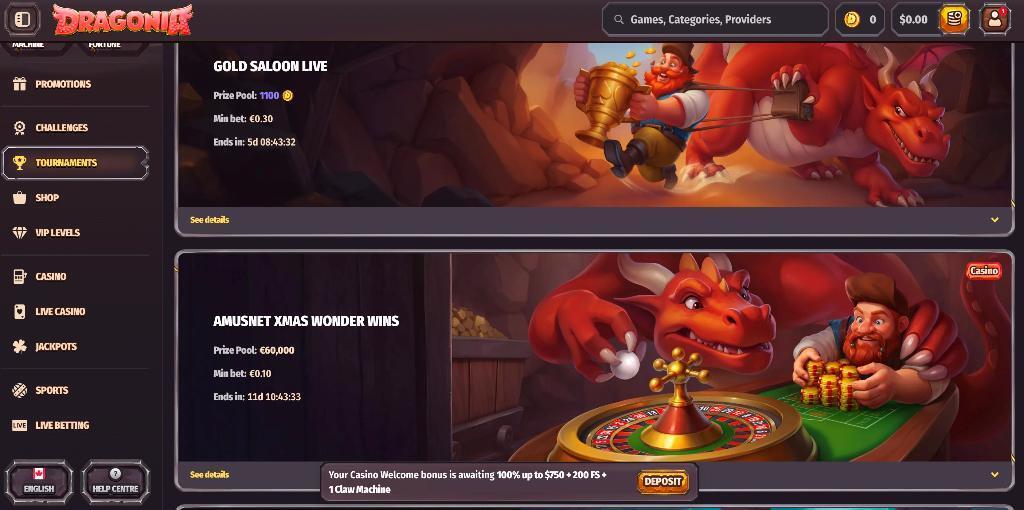
What to expect: Dragonia runs a rotating schedule of slot competitions, with leaderboard events tied to specific game titles as well as open-format races. The tournament lobby lists active and upcoming events, including entry requirements and prize structures. Popular recurring tournaments include the Win Booster, Slot Masters, and a monthly Cashcrab race.
Observed during testing: The tournament lobby was accessible and reasonably well-organised. Prize structures varied — some events offered cash prizes to a broad range of finishers, while others concentrated rewards at the top of the leaderboard. Minimum bet requirements were visible, though we’d recommend reading the full terms for each event before entering.
Limitations: Withdrawals can take up to three business days, which is worth noting if you’re hoping to access tournament winnings quickly. Responsible gambling tools were more limited than we’d expect from a well-rounded platform.
BlueChip Casino — Variety of ongoing tournaments
Tournament type: Daily in-house tournaments plus network promotions, including Spinoleague by Spinomenal, Drops & Wins by Pragmatic Play, and the in-house “Jump in a Plane” tournament on AviatriX.
Game library: 4,000+
License: Curacao Gaming Control Board

What to expect: BlueChip Casino combines fast crypto payouts and strong mobile performance with a steady mix of promotions and tournaments. Alongside its 4,000+ game library, players can join large network campaigns with multimillion-dollar prize pools or opt for smaller in-house events with lighter competition. The platform is built for easy movement between slots, live tables, and sportsbook betting, with a mobile app that offers full account and gameplay access.
Observed during testing: Several ongoing tournaments were available during testing, including Spinoleague and Drops & Wins. These wider network promotions featured very large prize pools but also attracted players from thousands of casinos, making competition intense.
Limitations: BlueChip does not support e-wallets such as Skrill, Neteller, or PayPal, which may frustrate players who prefer those payment methods. Its progressive jackpot selection is also more limited than at some competing casinos. Large promotional campaigns can be highly competitive, so players looking for better odds may prefer smaller in-house events.
Playfina — Daily, weekly, and monthly tournament cycle
Tournament type: Daily Spins Race, Weekly Slots Tournament, Weekly Live Tournament, and the Book of Billionaire monthly event (Fugaso slots)
Game library: 7,000+
License: Curaçao Gaming Control Board

What to expect: Playfina maintains a consistent tournament schedule across different timeframes, which means there’s usually something active regardless of when you log in. The Daily Spins Race distributes prizes across up to 400 positions — a wider distribution than many comparable events. The Book of Billionaire tournament is tied to a specific game provider and carries a large stated prize pool.
Observed during testing: The multi-tier structure (daily, weekly, monthly) gives players flexibility, but it also means tracking multiple sets of terms simultaneously. The live dealer tournament pays out to 100 winners weekly, which is a relatively broad distribution for that format.
Limitations: Playfina charges a fee for inactive accounts, which is worth noting if you participate in a tournament and then step away from the platform. There is no dedicated mobile app — mobile play is via browser only.
Nova Jackpot — Regular competitions with accessible entry points
Tournament type: Slot of the Week, Drops and Wins, Elamania 4, and a CashCrab Monthly Race; approximately seven active tournaments observed
Game library: 10,000+
License: Curaçao Government

What to expect: Nova Jackpot’s qualifying bet threshold starts at $0.15, which makes entry accessible for players who prefer lower-stakes play. The Slot of the Week format rotates the featured game weekly and distributes prizes across a set number of positions. The CashCrab Monthly Race is a provider-run event that appears across multiple casinos.
Observed during testing: The stated maximum prize pool figures (up to $2,000,000) reflect the provider-level Drops & Wins programme rather than casino-specific prize pots — it’s worth understanding the distinction, as these figures represent the total distributed across all participating players at all participating casinos, not the prize available to any single player.
Limitations: Wagering requirements on bonus prizes were on the steeper side in our review. No dedicated mobile app is available.
GoldSpin — Daily cash tournaments with weekly challenges
Tournament type: Daily cash tournaments and weekly casino challenges; two primary tournament formats observed
Game library: 12,000+
License: Curaçao Gaming Control Board

What to expect: GoldSpin’s tournament offering is narrower than some of the other platforms listed here, but the daily format means there’s consistent access to competitive play. Prize structures are cash-based, which is preferable to bonus credit from a practical standpoint. The weekly challenge runs alongside the daily events for players who want a longer competition window.
Observed during testing: The daily tournament format was straightforward to enter and the scoring logic was clearly explained. The smaller number of tournament types means less variety, but also less complexity in tracking multiple events simultaneously.
Limitations: Withdrawal limits are on the lower end, and there is no dedicated mobile app. Players who regularly withdraw larger amounts may find the limits restrictive.
How Tournament Prizes Work
Understanding the prize structure before entering is as important as understanding the scoring rules. The three main formats you’ll encounter are:
- Percentage-based prize pool: A portion of all qualifying wagers or entry fees is collected and distributed among the top finishers. The pool grows with participation, but so does the competition. Final prize amounts often aren’t confirmed until the tournament closes.
- Fixed prize pot: The prizes are set in advance and don’t change based on participation. This gives you a clear picture of what you’re competing for before you enter. Fixed-pot events are generally easier to evaluate when comparing tournaments.
- Winner-takes-all: The entire prize goes to the top-ranked player. These events are less common in casual formats and tend to be higher-stakes. The vast majority of participants receive nothing.
Reviewer’s tip: Beyond the structure, check whether prizes are paid as cash or bonus credit. Cash prizes can typically be withdrawn subject to standard verification requirements. Bonus credit carries wagering conditions — sometimes significant ones — before any withdrawal is possible. This distinction is often buried in the terms and conditions rather than highlighted in the tournament promotion.
Tournament Rules: What to Read Before You Enter
Tournament terms vary between platforms and between individual events on the same platform. The following are the key variables to check before committing to any competition.
- Opt-in requirement: Some tournaments require manual opt-in before your activity counts. If you start playing qualifying games without opting in first, those rounds typically won’t register on the leaderboard.
- Time window: All tournaments have a defined start and end time. Activity outside that window doesn’t count.
- Minimum bet: Most tournaments specify a minimum qualifying stake. Bets below that threshold don’t contribute to your score, even if you’re playing the correct game. This is particularly relevant for slot tournaments, where the minimum is often per spin.
- Qualifying games: Some events apply to a broad range of games; others are restricted to specific titles or games from a single software provider.
- Scoring method: As outlined above, scoring logic varies. Confirm whether points are awarded for spin count, win multipliers, total wagered, or winning rounds.
- Prize distribution: Check how many players receive prizes and how the pool is split. A tournament with 1,000 participants paying out to 10 finishers is a different proposition to one paying out to 100.
Are Casino Tournaments Worth It?
That depends on what you’re comparing them to and what you’re hoping to get from them.
The Advantages:
- Tournaments add a defined competitive structure to sessions that might otherwise be open-ended, which some players find useful for managing play time
- Fixed-prize formats offer transparency about potential outcomes before you enter
- Events that distribute prizes across many leaderboard positions (rather than concentrating rewards at the top) can offer reasonable value for consistent players
- For skill-based formats like poker, tournament play rewards preparation and decision-making in a way that pure luck-based games don’t
Trade-offs and Considerations:
- Tournament structures can incentivise extended or higher-volume play to maintain leaderboard position — which can lead to spending more than originally planned
- Prize pools that sound large often reflect provider-level totals distributed across thousands of players at many casinos, not a single prize available to you
- Bonus credit prizes carry wagering requirements that significantly reduce their practical value compared to equivalent cash prizes
- Many tournaments are structured so that only a small percentage of participants receive anything — large fields with top-heavy prize distributions can mean the realistic odds of receiving a prize are low
- Time-limited events (particularly daily tournaments) can create pressure to play within specific windows, which doesn’t suit everyone’s schedule
If you’re drawn to tournaments, the most useful thing you can do is read the terms carefully before entering — specifically the scoring method, the prize format (cash vs bonus), the distribution of prizes across leaderboard positions, and the minimum bet requirements.