



Poker works on film not despite the cards, but because of what happens between them. However, the problem is that what we see on film isn’t how poker really works. That’s why poker films are so important: they don’t just entertain; they help us make sense of the game before we ever play a hand.
Why Poker Works So Well on Screen
Unlike most casino games, poker is founded upon human interaction. You’re not playing against a system; you’re playing against humans.
This provides the filmmaker with incredible assets:
- Psychological tension
- Bluffing and deception
- High-stakes decisions
When you understand the fundamentals of poker, you’ll know that poker is far more than any single “big moment”. It’s about making small decisions repeatedly.

The Psychology Poker Movies Get Right
1. Poker as a mental game
Movies like “Rounders” are, in a way, true to the subject matter because poker really is a game of incomplete information. You’re constantly trying to read people. What stands out, on rewatch, isn’t the famous hands. It’s the restraint. The waiting. The discipline.
2. Ego vs discipline
In “Lucky You”, the emotional stakes aren’t the cards; they’re the inability of the protagonist to walk away. When talking about “Lucky You” from a critical standpoint, the thing that stands out most is how relatable the conflict feels. Not exciting, but quietly damaging. Poker is a game that punishes impatience and reinforces the importance of knowing when to step away. The film understands that, even if it doesn’t always portray the results.
3. Pressure, tilt and emotional drift
In many poker films, players crack under the pressure. Although the idea of “tilt” is an exaggeration, it is an extremely realistic phenomenon. Something that the films do well is portray the speed at which decision-making deteriorates once emotions take over. However, what the films do not do so well, is portray the process of recovering from “tilt”. Which does not happen in a single hand for real players.
Where Movies Start to Drift from Reality
- The Myth of the Perfect Read
Players in the movie make dramatic decisions based on a single “tell” – a look, a gesture, a beat of the heart. In the real world, however, even the best professionals base their decisions on probability, patterns, and long-range trends. Not on a single, defining instant.
- The Obsession with Big Hands
Movies seem to centre their dramatic moments around the biggest possible hands: full houses, straight flushes, dramatic all-ins. For instance, even classics like Casino Royale are often criticized for depicting the combination of multiple high-ranking hands into a single dramatic moment, which is unlikely in the real world.
- Ignoring Variance
Perhaps the greatest distortion of all is this: movies show time compressing. Movies show winning streaks, redemption stories, and climactic victories, but they don’t show losing streaks, and they don’t show them in detail. In real life, variance is king in the short term, and even good players lose a great deal. And often, they lose in ways that movies rarely show, highlighting the unpredictability of real poker.
Films That Capture Different Sides of Poker
The Cincinnati Kid
This movie doesn’t feel like a poker movie, really, it feels like a character study. What I remember is not the final hand, but the weight of expectation. The idea that one hand defines a player. It’s true, but not really true in poker. One hand doesn’t define anything.

Steve McQueen plays Eric Stoner a.k.a. “The Cincinnati Kid” as he goes on a journey from small-time New Orleans poker games to the top of the game. It’s set in the 1930s, which adds to the overall feeling of nostalgia that reminds us why people start playing.

Molly’s Game
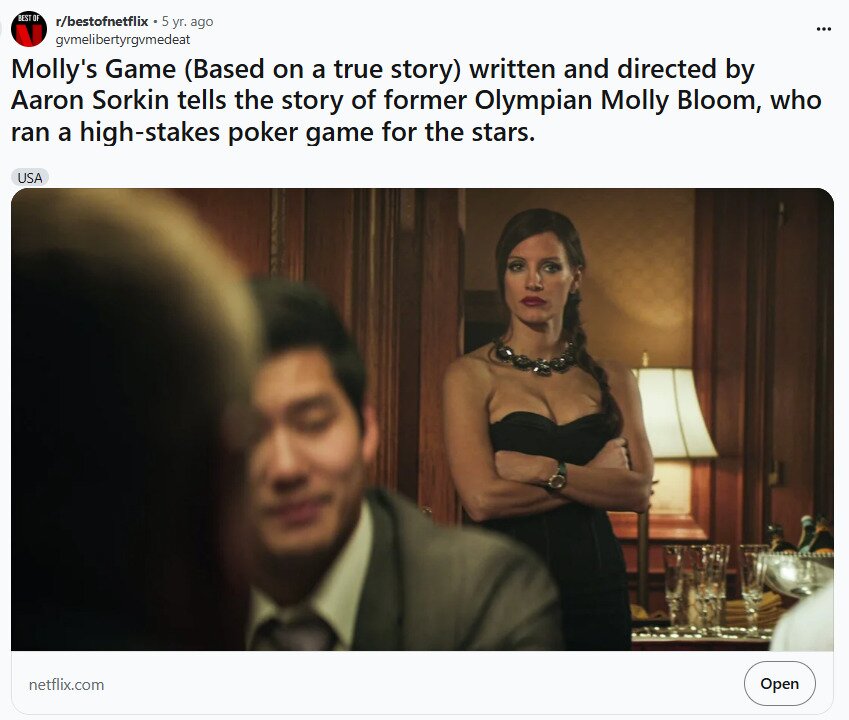
This movie details the real-life story of Molly Bloom, played by Jessica Chastain. What makes this story compelling isn’t the rise, it’s how control slowly replaces risk. It reframes poker as something structured, not chaotic. Molly transforms from an Olympics-qualified skier into the boss of one of the biggest underground poker rings in the world. It’s a story you have to see to believe.
Instead of gameplay, Molly’s Game focuses on the ecosystem of poker – power, access, and control.
It’s a reminder that poker culture isn’t just about cards, it’s about people, status, and risk tolerance.

Mississippi Grind
What makes this film successful isn’t so much the journey, but the interplay between the two characters, one of whom is chasing recovery, and one of whom is chasing possibility, both of whom are chasing something that isn’t exactly based in reality. It’s something that any poker player will tell you is immediately apparent: the attachment of significance to a series of outcomes, good or bad.
This one feels like the most realistic of them all. There’s no clear progression, no clear winning
streaks, just a general air of uncertainty, hope, and emotional degradation. It’s uncomfortable in a way that most other poker movies avoid, and that’s exactly why it works.
What Poker Movies Rarely Show
- The Volume of Play: Real poker is a game of repetition, with many hands, small edges, and gradual outcomes.
- Bankroll Management: Critical in reality, almost invisible in film
- Sustained Loss: Not dramatic enough for cinema but central to the game
Why These Movies Still Matter
Even though exaggerated, poker movies contribute to the cultural perception of the game:
- Makes the game look dramatic and strategic
- Introduces the game to new audiences from a psychological standpoint
- Makes decisions look like storytelling events
Poker movies aim to create tension and focus on key moments, not long-term realism.
- Movies depict poker as a string of defining moments
- Real poker is just a long string of uncertain decisions
Poker movies don’t teach you how to play. They teach you how poker feels or at least, how we want it to feel. And that distinction matters more than it seems.
