

What keeps Canadians up at night? To find out, we surveyed 1,150 Canadians across every province and territory, asking them to identify their top fears, rate how intensely they feel them, and say whether anything could convince them to face their biggest fear.
The results reveal a country whose anxieties vary depending on where people live — and whose most commonly selected fears have far less to do with the supernatural than many might expect.
Key Takeaways from the 2026 Canada Fear Index
- Financial worries lead nationally: 42% of Canadians selected financial worries as one of their top fears.
- Newfoundland and Labrador records the highest financial-fear result: 52% of respondents selected financial worries.
- The territories break from the national pattern: spiders lead in Yukon and Nunavut, while fear of failure ranks first in the Northwest Territories.
- Fear intensity averages 6.6 out of 10 across Canadian respondents.
- Nearly one in five Canadians would not face their biggest fear for any amount of money.
Fear has a new face:
Drawing on a nationwide survey of 1,150 verified Canadian adults, the 2026 Canada Fear Index provides a detailed picture of how fear varies by province, territory, age and gender.
Powered by Pollfish, the study asked respondents to select up to three fears from a predefined list, rate the intensity of their biggest fear, and answer questions about what it would take for them to face it.
What surprised us most wasn’t that Canadians fear financial pressure — it’s how consistently that fear appears across the country. The territories are where a different pattern begins to emerge, and that contrast offers a revealing look at how everyday risk can vary between communities.
– Scott MacDonald
Canada’s Biggest Fears Revealed
Across Canada, financial pressure dominates the national fear landscape. Financial worries were selected by 42% of respondents, placing them ahead of public speaking, spiders, snakes and fear of dying.
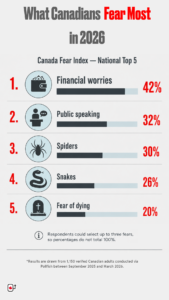
Here are the five most commonly selected fears nationally:
- Financial worries — 42%
- Public speaking — 32%
- Spiders — 30%
- Snakes — 26%
- Fear of dying — 20%
Respondents could select up to three fears, so the percentages do not total 100%.
Newfoundland and Labrador records Canada’s highest level of financial concern, with 52% of respondents selecting financial worries as one of their top fears. Saskatchewan follows at 47%, while New Brunswick and Prince Edward Island each record 46%.
How Fear Differs by Gender
Women and men largely agree that financial worries belong at the top of the list, but the fears that follow show clear differences.
| Fear | Women | Men |
| Spiders | 35% | 25% |
| Failure | 22% | 29% |
| Illness | 20% | 27% |
Women are more likely to select spiders as a top fear, while men report higher levels of fear around failure and illness.
Province by Province: Canada’s Fear Map
Financial worries lead in every province, but Canada’s northern territories break sharply from the national pattern. Spiders rank first in Yukon and Nunavut, while fear of failure leads in the Northwest Territories.
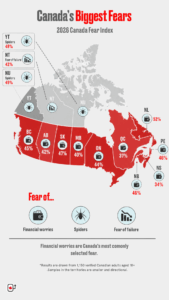
This table presents the most commonly selected fear in each province and territory:
| Province or Territory | Most Commonly Selected Fear | Percentage |
| Alberta (AB) | Financial worries | 42% |
| British Columbia (BC) | Financial worries | 45% |
| Manitoba (MB) | Financial worries | 40% |
| New Brunswick (NB) | Financial worries | 46% |
| Newfoundland and Labrador (NL) | Financial worries | 52% |
| Nova Scotia (NS) | Financial worries | 34% |
| Ontario (ON) | Financial worries | 44% |
| Prince Edward Island (PE) | Financial worries | 46% |
| Quebec (QC) | Financial worries | 37% |
| Saskatchewan (SK) | Financial worries | 47% |
| Yukon (YT) | Spiders | 48% |
| Nunavut (NU) | Spiders | 49% |
| Northwest Territories (NT) | Fear of failure | 42% |
Northwest Territories (n=52), Nunavut (n=33) and Yukon (n=65) have smaller sample sizes. Their results should be treated as directional rather than statistically representative.
What the findings suggest:
- Financial pressure is widespread: it ranks first in every Canadian province included in the study.
- Atlantic Canada contains some of the highest results: Newfoundland and Labrador leads nationally at 52%, while New Brunswick and Prince Edward Island each record 46%.
- The territories follow a different pattern: spiders lead in Yukon and Nunavut, and fear of failure ranks first in the Northwest Territories.
How Fear Changes with Age
Younger Canadians aged 18 to 30 divide their top fears almost evenly between financial worries, spiders and public speaking, with each selected by roughly 37% of respondents in that age group.
Among Canadians in their 30s and early 40s, financial anxiety moves decisively ahead at 45%. For respondents aged 46 to 64, illness rises to 31%, reflecting a greater focus on health as people grow older.
Fear of death peaks among 31- to 45-year-olds at 21% and falls slightly to 19% among respondents aged 46 to 64.
How Intense Are Canadians’ Fears?
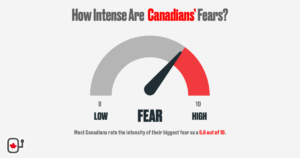
The result also shows that fear does not need to involve an immediate physical threat to feel intense. Financial pressure, social situations, health concerns and fear of failure can all shape how people assess uncertainty and make everyday decisions.
Fear is more than a fleeting emotion. It shapes how people assess uncertainty, make decisions and respond to pressure. The results show that many of the fears Canadians feel most strongly are rooted in everyday life rather than in extraordinary events.
– Scott MacDonald
The Price of Facing Your Biggest Fear
A third of Canadians said they would only face their biggest fear for a significant financial reward. Thirty-three percent would require at least $10,000, while 19% said no amount of money would convince them.
At the other end of the scale, 16% said they would face their biggest fear for $100 or less.
The provincial findings add another layer:
- New Brunswick is the most reluctant: 31% said no amount of money would convince them to face their biggest fear.
- Quebec follows: 27% said they would not face their biggest fear for any amount.
- Prince Edward Island and British Columbia are the most willing: 18% of respondents in each province said they would face their fear for $100 or less.
Important context:These findings describe how respondents value the prospect of facing a fear. They should not be interpreted as financial advice or as suggesting that gambling is a response to financial pressure.
What Canada’s Fears Reveal
Canada’s Fear Index 2026 shows that fear is universal, but it is not experienced in the same way everywhere. Financial worries dominate across the provinces, while the territories produce a markedly different pattern involving spiders and fear of failure.
The findings also show how fear changes across age and gender, and how differently Canadians weigh discomfort against potential reward.
From Ontario to Newfoundland and Labrador, financial pressure appears with striking consistency. The regional exceptions are equally important because they show that fear is shaped by local circumstances, personal experience and the kinds of risk people encounter in everyday life.
— Scott MacDonald
Fair Use
Maple Casino encourages the sharing and republication of this research. All data, findings, charts and graphics from the Canada Fear Index 2026 are free to use for editorial, educational and journalistic purposes, provided that Maple Casino is credited as the source and a link back to this page is included.
To reproduce this research in full or use it in a commercial context, please contact us directly.
Methodology
Canada’s Fear Index 2026 is based on an online survey of 1,150 verified Canadian adults, conducted via Pollfish between September 2025 and March 2026.
Respondents were distributed across all provinces and territories and asked to select up to three fears from a predefined list of 16 options, rate the intensity of their biggest fear on a scale from 0 to 10, and answer questions about risk tolerance.
Responses were balanced by age, gender and province. Northwest Territories (n=52), Nunavut (n=33) and Yukon (n=65) have smaller sample sizes, so findings from these regions should be treated as directional rather than statistically representative.
Media Contact
For media enquiries, interview requests or additional data cuts, contact: pr@maplecasino.ca
Behind the data: about Maple Casino
Maple Casino is dedicated to helping Canadians make informed and safer choices in the evolving iGaming landscape through research, practical information and experience-based casino reviews.
Our data-led approach supports clear, responsible coverage of how Canadians understand risk and uncertainty. Gambling should always be treated as entertainment and never as a way to address financial concerns.